RCLIP
Waseda University’s Research Center for the Legal System of Intellectual Property (RCLIP)
Next Event
RCLIP Evening Seminar
Bernt Hugenholtz, Training AI models on copyright content: which country's law applies?
Publications
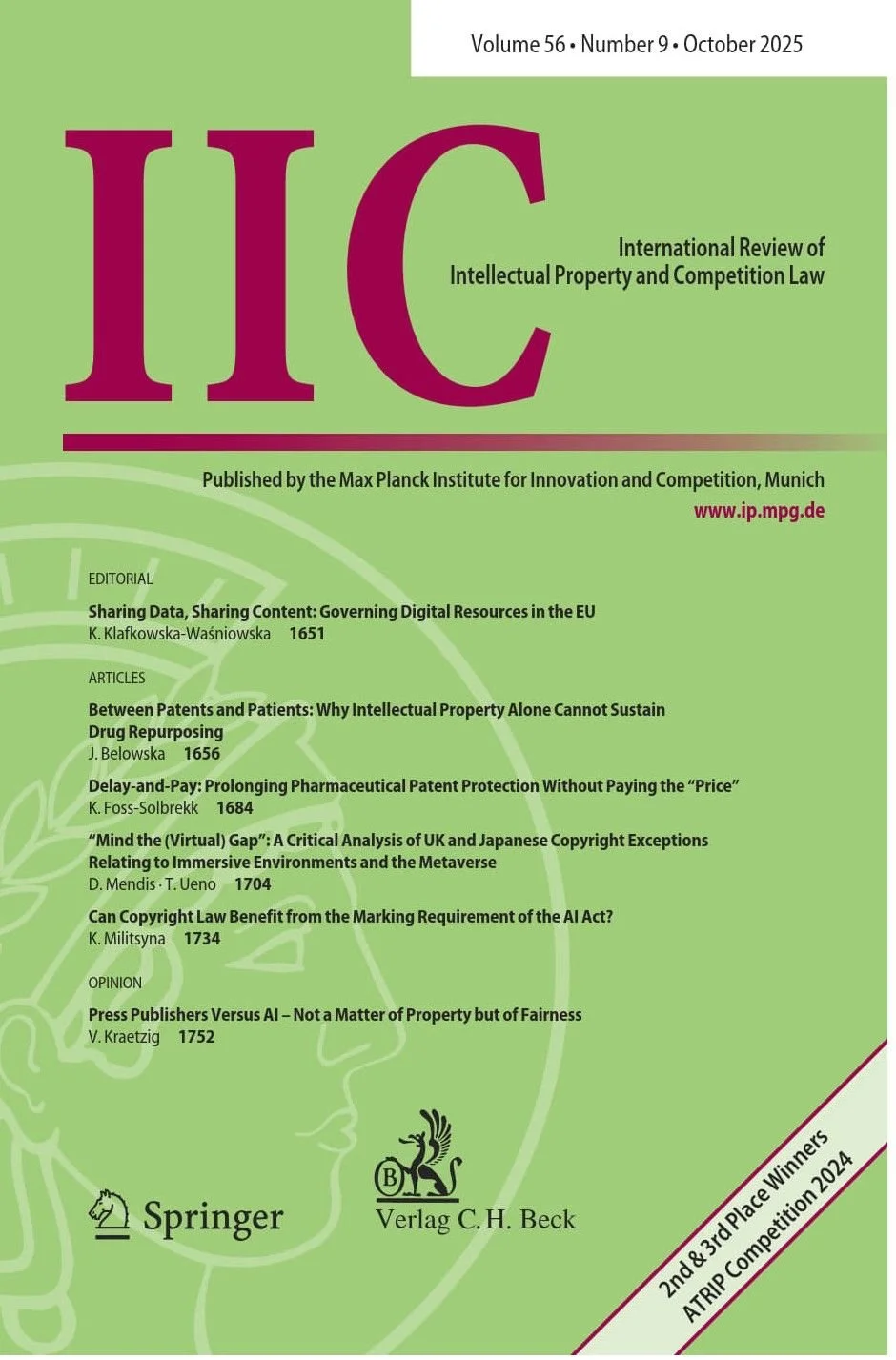
Prof. Ueno published an article on the copyright issues in Metaverse with Prof. Dinusha Mendis in IIC.
This annual report is a must-have for those involved in the field in Japan, providing an up-to-date overview of court precedents, academic theories, policies and industry, and foreign trends over the past year. Important topics are explained in special features and other articles.
Column
Makoto Hattori shares his insights from this year’s International Symposium on Intellectual Property Courts (JSIP) has been held annually, co-hosted by the Supreme Court of Japan, the Ministry of Justice, the Japan Patent Office, the Japan Federation of Bar Associations, and the Intellectual Property Lawyers Network.
WIPO Member States held final negotiations on a New Treaty on Intellectual Property, Genetic Resources and Associated Traditional Knowledge at WIPO Headquarters in Geneva from May 13-24, 2024, with Ambassador Guillerme de Aguiar Patriotta, Brazil's Permanent Representative to the World Trade Organization (WTO), chairing the diplomatic meeting which culminated in consensus approval of the new WIPO Treaty. I take this opportunity to share some considerations on the new WIPO Treaty, since Brazil was the leader of the final discussions and the subject is of great interest to Brazil.
Asian IP News
One of the more consequential yet relatively underreported developments in Thailand’s emerging AI governance framework is the ongoing discussion surrounding a copyright exception for text and data mining (TDM), raising the broader question of whether Thai copyright law can support the data-intensive innovation model on which modern AI depends. Against longstanding uncertainty over the scope of copyright exceptions under Thai law, this article compares emerging approaches in Japan, the European Union, the United Kingdom, and the United States and assesses the trade-offs between legal certainty for AI development and protection of rightsholders. It argues that Thailand’s eventual choice—whether to adopt a broad or conditional TDM exception, rely on existing copyright doctrines, or pursue a licensing-based solution—will be an important signal of how the country intends to balance copyright protection, creative-industry interests, and AI competitiveness.
ASEAN’s new ASPEC+ framework marks a cautious but meaningful shift from passive patent work-sharing toward active coordination among national IP offices. While far from a unified regional patent system, it may become an important test of whether procedural cooperation can gradually produce deeper convergence in ASEAN patent examination.
Waseda University and the Research Center for the Legal System of Intellectual Property (RCLIP) are located in the heart of Tokyo, Japan.